Comet 1P/Halley
Comet Halley is definitely the most famous of all comets.
Although it has a rather long period of revolution (about 76 years),
it has probably been observed since the year 468 B.C. (or -467) when the first
record by Chinese observers was dated (there are also Greek records which are
related to this Halley apparition, and more dubious records of possible
apparitions in 1059-8 B.C. from China, and 2467 B.C.).
It was observed and recorded at all of its last 30 apparitions (perihelia) from
241 B.C. to 1986 A.D.; its next return will occur in 2061.
While in more ancient times, the comet was merely observed for histographical,
religious, astrological and perhaps even more esoteric reasons, all its
apparitions since 1531 have contributed to scientific advance:
- In 1531, Peter Apian observed that the comet's tail was always
oriented into the direction away from the sun.
- In 1607 it was observed by Johannes Kepler and Longomontanus.
Kepler thought it was moving along a straight line through the solar system.
- In 1682, the comet was observed by
Edmond
Halley. By comparing the orbital elements derived from his own
observations with that of the comet apparations of 1531 and 1607, he concluded
that these three were the same object, and in 1705,
he predicted its return
in late 1758 or early 1759.
- In 1758 and 1759, astronomers (in particular the young
Charles
Messier) took considerable effort to find the comet's predicted
return. The comet was eventually found by the German amateur astronomer
Johann
Georg Palitzsch
on the night of December 26-27, 1758. The comet was eagerly traced by a
number of astronomers up to June 1759.
- In 1835, on its second predicted return, the comet was investigated e.g. by
Friedrich
Bessel, who concluded that non-gravitational "rocket" or "jet"
effects might change the comet's orbit unpredictably.
- In 1910, the first photos and spectra of comet Halley were obtained (e.g. on
Lick and Mt. Wilson Observatories).
- In 1986, (uncrewed) spacecraft investigated comet Halley for the first time.
ESA's Giotto performed a particularly sophisticated close encounter and
returned exciting images and data of Halley's nucleus and coma.
We can only speculate what will be done on the comet's next return in 2061.
Comet Halley just has passed its aphelion quietly on December 9, 2023, and
is closing in again, for its 2061 apparition.
The comet is looked forward to reappear in 2061, and pass its perihelion on
July 28, 2061. It is expected to recede again, for its next aphelion passage on
November 21, 2097, and then close in again to pass the next perihelion on
February 26, 2134 (according to JPL ephemerides).
Links:
Comet Halley Images:
-
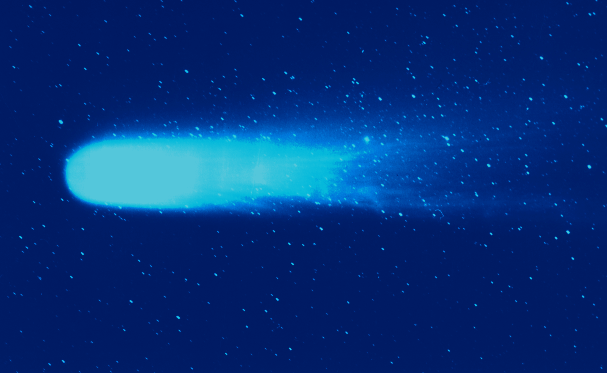
Lowell Observatory image of Comet P/Halley 1910, computer enhanced
false-color for brightness levels done at KPNO.
- Dead Link!
1P/Halley Images (actually lightcurves), JPL
- Anglo Australian Observatory / U.K. Schmidt Telescope images of Comet
Halley:
-
AAT 46:
Halley's Comet on December 9, 1985 (AAT)
- UKS 39:
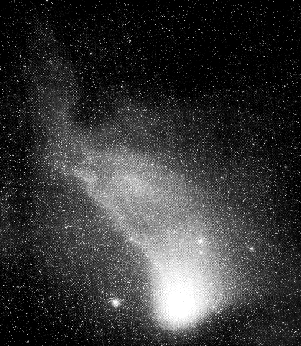
The tail of Comet Halley on 9 December, 1985 (UKS)
- AAO3 16:
Comet Halley on December 9, 1985 (AAT)
- AAO4 75:
Comet Halley on December 9, 1985 (David Malin)
- AAO4 76:
Comet Halley on December 9, 1985 (David Malin)
- AAO4 74:
Comet Halley on December 15, 1985 (David Malin)
-
UKS 19:
Halley's Comet on 12 March, 1986 (UKS)
-- UKS 19a:
unsharp masked b/w image with ion tail enhanced
- AAO4 77:
The tail of Comet Halley on March 12, 1986 (David Malin)
-
AAT 117:
Comet Halley on April 9-10, 1986 (AAT)
-
UKS 34:
Comet Halley on April 9-10, 1986 (UKS)
-
AAO3 07
(former Misc 20):
Comet Halley hanging in the Milky Way in April 1986 (by David Malin)
- ESO images of Comet Halley:
-
Comet Halley captured at mag 28.2, distance 4.2 billion km (28.06
AU) from Sun, March 6-8, 2003. ESO VLT image.
- Dead Link!
Comet Halley Images
by Giotto (NEO Program, JPL)
- Comet Halley Images at SEDS:
Amateur images of Comet Halley:
Miscellania related to Halley:
- "I came in with Halley's Comet in 1835. It is coming again next year
(1910), and I expect to go out with it. It will be the greatest
disappointment of my life if I don't go out with Halley's Comet."
- Mark Twain (1835-1910)
(see Mark Twain
Quotes)
Observed and Future Apparitions of Comet 1P/Halley
  Year  No  Comet Designations

  -239   1  1P/-239 K1
  -163   2  1P/-163 U1
   -86   3  1P/ -86 Q1
   -11   4  1P/ -11 Q1
    66   5  1P/  66 B1
   141   6  1P/ 141 F1
   218   7  1P/ 218 H1
   295   8  1P/ 295 J1
   374   9  1P/ 374 E1
   451  10  1P/ 451 L1
   530  11  1P/ 530 Q1
   607  12  1P/ 607 H1
   684  13  1P/ 684 R1
   760  14  1P/ 760 K1
   837  15  1P/ 837 F1
   912  16  1P/ 912 J1
   989  17  1P/ 989 N1
  1066  18  1P/1066 G1
  1145  19  1P/1145 G1
  1222  20  1P/1222 R1
  1301  21  1P/1301 R1
  1378  22  1P/1378 S1
  1456  23  1P/1456 K1
  1531  24  1P/1531 P1
  1607  25  1P/1607 S1
  1682  26  1P/1682 Q1
  1759  27  1P/1758 Y1  1759 I
  1835  28  1P/1835 P1  1835 III
  1910  29  1P/1909 R1  1910 II    1909c
  1986  30  1P/1982 U1  1986 III   1982i
  2061  31
  2134  32
Hartmut Frommert
[contact]
![[Comets]](../Jco/hb.ico.jpg)
![[Spider] @](../Jco/spider.ico.jpg)
![[SEDS]](../Jco/seds.jpg)